
BSc (Hons), MSc (Hons), PhD (Hons)
Physical, Chemical, and Mechanical properties of materials, composite materials, and structures; encompassing destructive and non-destructive testing, design and manufacturing.
R&D Engineer
CERN, the European Organization
for Nuclear Research
Switzerland
Postdoctoral Researcher
DLR, the German Aerospace Center
Germany
Honorary Research Fellow
University of Bristol
United Kingdom
Honorary Professor
Federal University of São João del-Rei
Brazil
Scientific Editor
Materials Today Communications
Elsevier
“If at first the idea is not absurd, then there is no hope for it.” ― Albert Einstein
"I am among those who think that science has great beauty." ― Marie Curie
Copyright © rjs.phd. All rights reserved.
⌬ ⌬ ⌬
Academic, Research & Leadership Roles
⚛︎ R&D Engineer at CERN (the European Organization for Nuclear Research, Switzerland), as a member of the Detector Technologies group in the Experimental Physics department (EP-DT).
⚛︎ Postdoctoral Researcher (Visiting Scientist) at DLR, the German Aerospace Center, in the Institute of Structures and Design, as a member of the Department of Component Design and Manufacturing Technologies.
⚛︎ Scientific Editor at Elsevier, managing the full peer‑review workflow as a member of the editorial board of the journal Materials Today Communications.
⚛︎ Honorary Research Fellow in the Faculty of Engineering of the University of Bristol (UK), at the School of Civil, Aerospace and Design Engineering.
⚛︎ Honorary Professor in the Department of Mechanical and Production Engineering of the Federal University of São João del-Rei (UFSJ, BR).
⚛︎ Founder & Leader of the Umbrella Research Group.
⌬ ⌬ ⌬
Academic Background
⚛︎ PhD in Materials Science (2025) from UFSJ, with a research exchange at the University of Bristol through the Aerospace Engineering Programme. Winner of the CAPES Award Thesis, as the best PhD thesis in the field.
⚛︎ Master's Degree in Mechanical Engineering (2020), specialising in Materials and Manufacturing Processes, and Bachelor's Degree in Mechanical Engineering (2017), both from UFSJ.
⌬ ⌬ ⌬
Research & Professional Activities
⚛︎ At CERN, acts in the structural analysis, materials selection and characterisation, and process development, with a focus on advanced structural and thermal composite materials for new detector designs in the current Large Hadron Collider (LHC), the High‑Luminosity LHC (HL‑LHC), and for the Future Circular Collider (FCC). Conducts research and development activities on vacuum beam pipe chambers, as well as on the testing and optimisation of future cryostats in carbon fibre reinforced polymers (CFRP) for CERN detectors.
⚛︎ At DLR, works on composites manufacturing and process optimisation with a focus on Automated Fibre Placement (AFP) of continuous‑fibre‑reinforced thermoplastic (CFRTP) architectures for ultra‑high‑vacuum (UHV) compatibility and extreme environmental conditions. Conducts research on metallic coating processes and graphene‑enhanced surface engineering to improve UHV performance of CFRTP components for advanced high‑energy‑physics applications.
⚛︎ Possessing extensive experience in Solid Mechanics and Structural Engineering, is engaged as a Research Collaborator at the Bristol Composites Institute since 2023, and at the Centre for Innovation and Technology in Composite Materials (CITeC) since 2018. Building on this long‑standing involvement, also holds honorary academic appointments at the University of Bristol (Research Fellow) and at the Federal University of São João del‑Rei (Honorary Professor), supporting research activities, supervising engineering projects, and contributing to teaching aspects across undergraduate and postgraduate programmes.
⌬ ⌬ ⌬
Research Outputs & Scientific Contribution
⚛︎ The academic portfolio includes 19 publications in high-impact, indexed journals, with 63% of them ranked in the Q1 tier for Impact Factor (JCR 2025). Has a productivity index of h-10. Outstanding contributions rely on a first‑author paper on sustainable metastructures published in the Q1 journal Advanced Composites and Hybrid Materials (Impact Factor 15.5), with an intellectual property patent arising from the research subject. Further remarkable production includes the RJS Method for the mechanical assessment of sandwich structures, named after the initials of the author, Rodrigo Jose da Silva, and supported by two associated papers published in the Q1 journal Composite Structures (Elsevier).
⚛︎ Held peer-reviewing roles for internationally recognised Q1 scientific journals issued by leading academic publishers, notably Journal of Cleaner Production, Acta Biomaterialia, Thin-Walled Structures, Journal of Building Engineering, Progress in Additive Manufacturing, Scientific Reports, and Food Chemistry.
⚛︎ Research interests include the design, fabrication, and characterisation of Composite Structures, Metastructures, and Metamaterials, utilising both destructive and non-destructive techniques. The research activities routinely integrate Applied Mathematics and Computational Methods, including Design of Experiments (DOE), Statistical Analysis (Minitab and R), Programming (MATLAB), 3D CAD Drawing & Modelling (Solidworks and Catia V5), Structural Simulation (ABAQUS), and Mathematical Modelling and Optimisation.
⌬ ⌬ ⌬
Innovation, Entrepreneurship & Scientific Outreach
⚛︎ Co-founder of EcoNux, a deep-tech startup developing sustainable engineering solutions based on bio-based composites and patented lightweight structural sandwich technologies for advanced industrial applications.
⚛︎ Inventor with patented technologies and software related to advanced materials and structural components, with a primary focus on high‑performance composite systems and innovative design solutions for aerospace, automotive, and next‑generation engineering applications.
⚛︎ Motivated by a deep passion for science and multidisciplinary learning, started the scientific journey during high school (2010-2012), earning multiple medals in Olympiads of Astronomy, Chemistry, and Mathematics.
⚛︎ Was founder, President, and lead teacher of the Resende Costa Scientific Institute (Instituto Científico de Resende Costa, 2017-2022), a non‑profit organisation dedicated to expanding science education in Minas Gerais state (Brazil) through academic olympiads, community outreach, and structured lessons in Astronomy, Chemistry, Mathematics, and Physics.
⌬ ⌬ ⌬
RJS Method
for mechanical assessment of sandwich structures
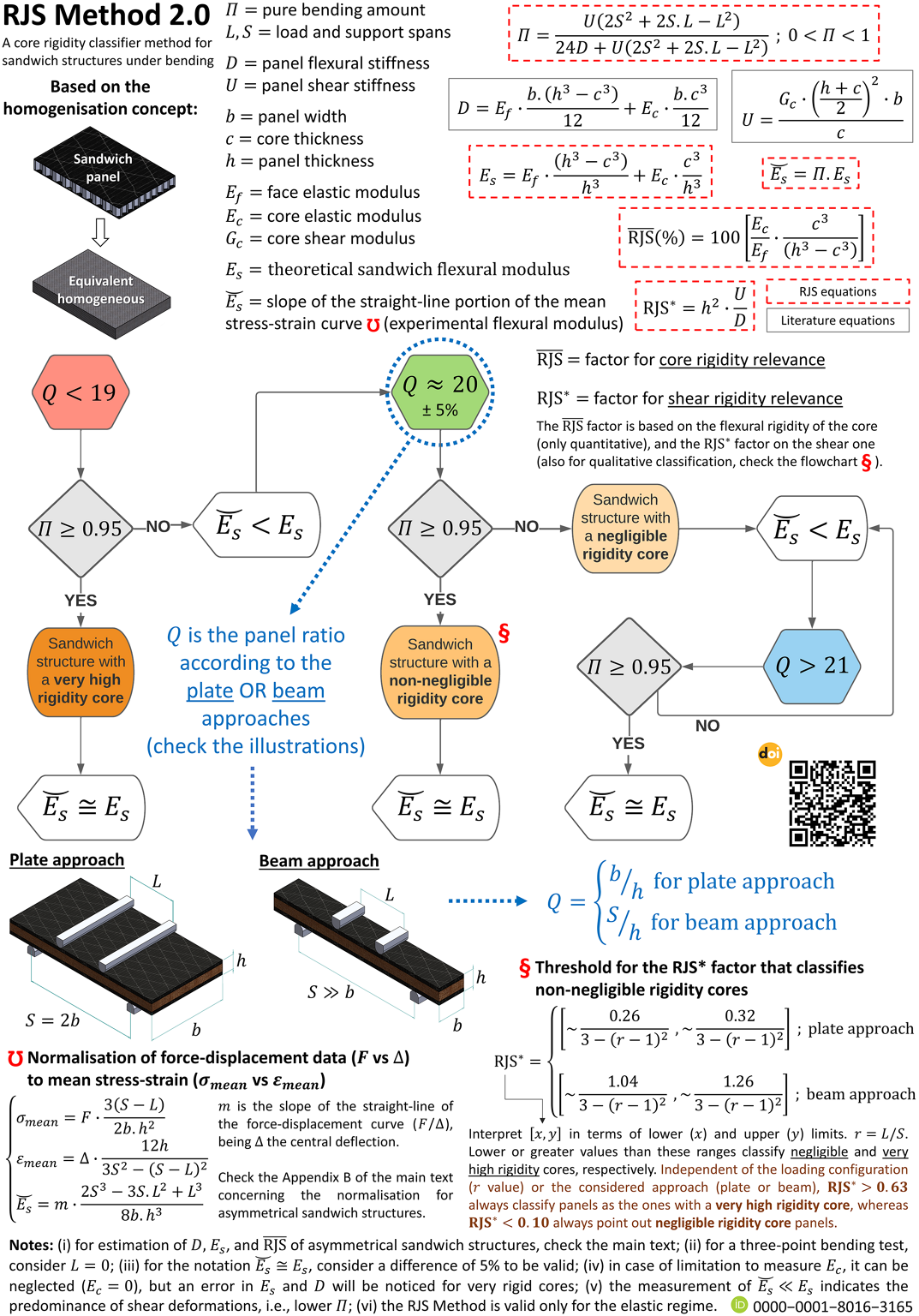
Named as the acronym for the initials of my name (Rodrigo José da Silva), the RJS Method presents innovative research concerning the mechanical characterisation of sandwich structures across bending tests employing universal testing machines. The method was authored by me in collaboration with research fellows and was published (2022) in the esteemed Q1 Journal Composite Structures (Elsevier). An enhanced version (2024) is published in the same Journal. Additionally, a classical comparison between the RJS Method and a traditional non‑destructive dynamic technique is published (2026) in the Journal Results in Engineering (Elsevier).
The ASTM standard D7250 that leads with the bending tests and elastic properties of sandwich structures admits only the contribution of the faces (also denoted as skins or facesheets) when theoretically estimating flexural stiffness. The reason why ASTM D7250 disregards the core contribution is primarily due to the complexity of core structures, which can have a variable moment of inertia along the cross-section of a panel. Originally, this disregard was motivated by the historical use of low-density and low-rigidity cores, such as foams, in sandwich structures. In such cases, the flexural stiffness of the panel is predominantly determined by the face contribution, making the neglect of core rigidity less problematic. However, this assumption becomes problematic when considering sandwich structures made from modern advanced core materials with high rigidity, which often lead to inaccurate predictions of structural behaviour and hinder the proper utilisation of the ASTM standard. The RJS Method, on the other hand, takes into account the core contribution by incorporating the concept of homogenisation, by assuming the moment of inertia of the core as constant and simply described as one-twelfth the product of the width and cube of the core thickness.
As a consequence of the homogenisation concept, the RJS Method also allows estimating the theoretical flexural modulus of sandwich structures, by dividing the theoretical flexural stiffness by the homogenised moment of inertia of the panel. This theoretical value can be compared to the experimental one obtained by employing universal testing machines. By measuring the slope of the straight-line portion of the mean stress-strain curve during a bending test, the experimental flexural modulus can be determined. Comparing the theoretical and experimental flexural moduli within the context of the RJS Method allows for an estimation of the shear deformations occurring during the bending test. If the experimental flexural modulus is significantly lower than the theoretical flexural modulus, it indicates a greater amount of shear deformations. Conversely, if the values of the theoretical and experimental flexural moduli are closer, it suggests that the panel is closer to experiencing pure bending. Initially, ASTM D7250 suggests using a short span length to promote relatively high shear deformations and a larger span to promote relatively high flexural deformations, aiming to achieve pure bending. However, there is a lack of specification on exactly how long or shorter these spans should be. In contrast, the RJS Method demonstrates that even under very short spans, a panel may undergo pure bending, and even under very long spans, significant shear deformations can still occur. This behaviour is dependent on the relative rigidity of the core compared to the rigidity of the faces.
Through the RJS Method, comparing theoretical and experimental flexural moduli allows us to properly assert the predominance of shear deformations (experimental flexural modulus lower than 50% of the theoretical one) or the predominance of flexural deformations (experimental flexural modulus greater than 50% of the theoretical one).
Finally, the RJS Method suggests some classifications for sandwich panels according to the core rigidity, and mathematical equations are proposed in order to quantify the core contribution to the overall rigidity of sandwich structures and predict the experimental flexural modulus under the occurrence of shear deformations.
My PhD
Materials Science
🥇 Winner of the
CAPES Thesis Award 2026
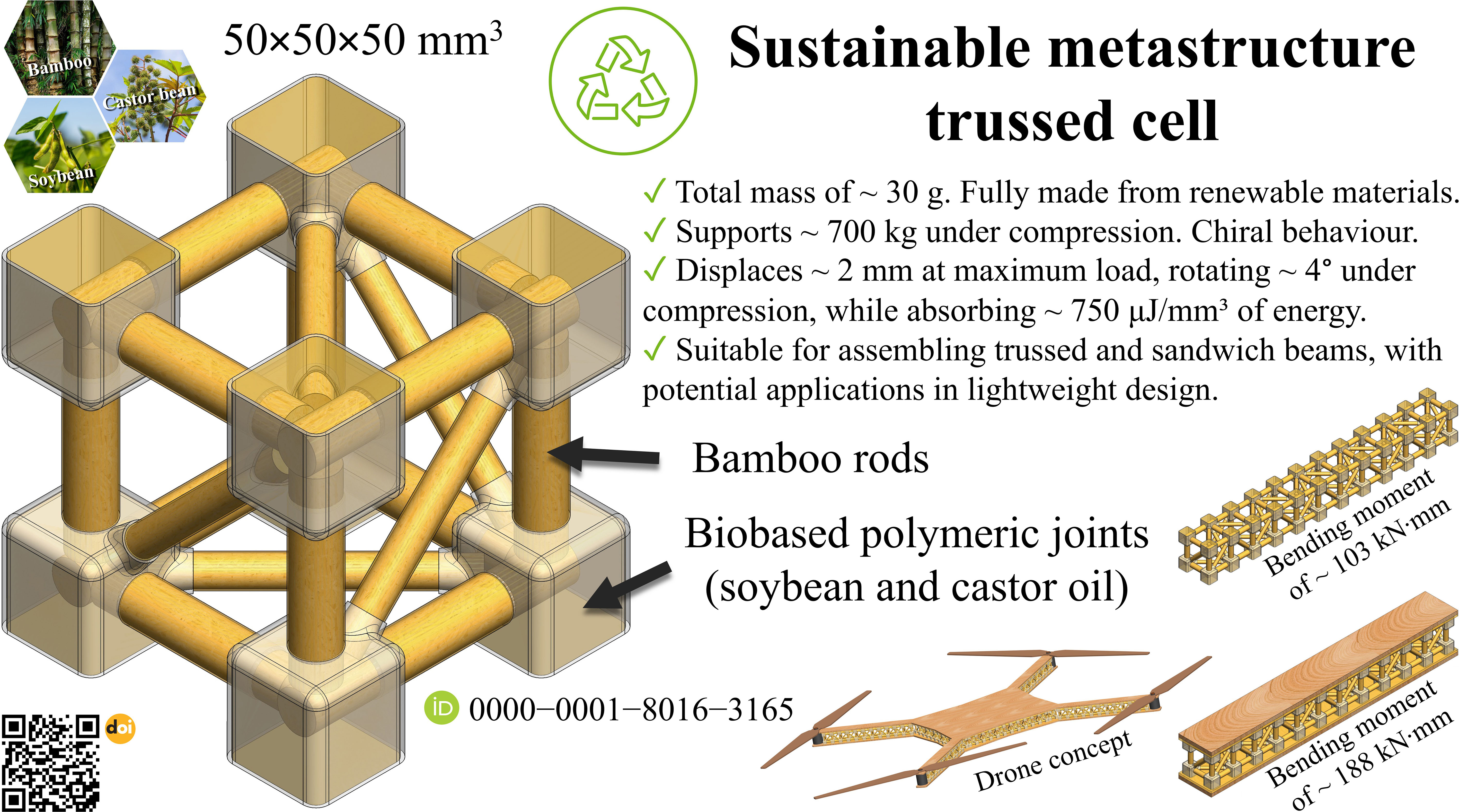
My PhD thesis, entitled "Sustainable composite design: a trussed metastructure made of bio-based materials", successfully demonstrated the design, fabrication, and testing of a metastructure trussed cell (50×50×50 mm³) composed of natural composite rods extracted from the giant bamboo (Dendrocalamus asper) and bi-phasic plant-based polymeric joints derived from soybean (Glycine max) and castor oil (Ricinus communis). The cells were engineered to exhibit chiral metabehaviour, rotating upon compression to absorb energy. A modular assembly was proposed, wherein these trussed cells were integrated into trussed beams (400×50×50 mm³). A sandwich beam was also fabricated, by associating the trussed beam as the core structure alongside 5 mm thick balsa wood skins. The experimental results showed that the metastructure trussed cell, with a mass of approximately 30 g, can support up to 700 kg under compression, with a displacement of ~ 2 mm, a rotation of 4°, and an energy absorption of ~ 750 μJ/mm³. Within the elastic regime of the trussed cell, sustained up to a displacement of 1 mm, a zero Poisson ratio was depicted alongside a force-displacement slope of ~ 4,200 N/mm. The trussed and sandwich beams exhibited equivalent densities of ~ 0.19 and ~ 0.21 g/cm³, respectively, and performed exceptionally well under bending loads, with the trussed beam supporting nearly 2,000 N (maximum bending moment of ~ 103 kN∙mm) and the sandwich beam achieving a loading capacity of nearly 3,600 N (maximum bending moment of ~ 188 kN∙mm). The modulus of toughness (energy absorbed under four-point bending prior to failure) was ~ 158 μJ/mm³ for the trussed beam and ~ 196 μJ/mm³ for the sandwich beam. Finite element analysis (FEA) models were successfully validated against the experimental data, demonstrating their accuracy in simulating the elastic behaviour of the structures. These validated models were effectively employed to investigate additional loading configurations, including torsion of the trussed cell and cantilever bending of the beams. The trussed cell depicts a response torque of ~ 7300 N∙mm for 1° of angle twist, while the trussed and sandwich beams have a homogenised flexural modulus under cantilever of ~ 623 MPa and ~ 751 MPa, respectively. The findings provided critical insights into the performance and potential applications of these sustainable materials in a variety of structural contexts, validating the potential of bamboo-based metastructures as renewable, high-strength, and lightweight alternatives for load-bearing components. Overall, the proposed bamboo-based metastructure trussed cell and its modular integration into trussed and sandwich beams represented a promising direction for enhancing sustainability and structural performance in fields ranging from civil construction to aerospace engineering.
List of scientific and technical publications related to the PhD research
1. Composite Structures (Elsevier) – Impact Factor 7.8 (JCR 2025)
📌 R.J. da Silva et al., “Enhanced core rigidity classifier method (RJS 2.0): a comprehensive approach to properly measure elastic properties of sandwich structures,” Composite Structures, Feb. 2024.
DOI: doi.org/10.1016/j.compstruct.2024.117981
🟡 Subscription access
2. Composites Part B: Engineering (Elsevier) – Impact Factor 14.0 (JCR 2025)
R.J. da Silva et al., “Natural composite rods extracted from the proximal section of the giant bamboo: statistical assessment of physical and mechanical properties,” Composites Part B: Engineering, Dec. 2024.
DOI: doi.org/10.1016/j.compositesb.2024.112081
🟢 Open access
3. Adv. Composites and Hybrid Materials (Springer Nature) – Impact Factor 15.5 (JCR 2025)
R.J. da Silva et al., “Fully bio-based composite and modular metastructures,” Advanced Composites and Hybrid Materials, Jul. 2025.
DOI: doi.org/10.1007/s42114-025-01359-1
🟢 Open access
TRUSSED STRUCTURAL CELLS COMPOSED OF RODS EXTRACTED FROM BAMBOO AND POLYMERIC JOINTS. Original title (PT-BR): CÉLULAS ESTRUTURAIS TRELIÇADAS COMPOSTAS POR HASTES EXTRAÍDAS DO BAMBU E JUNTAS POLIMÉRICAS. Patent number BR 10 2024 013083-9, deposited on 26 June 2024. Available at bit.ly/pat-truss. [Current status: DEPOSITED].
1. 📌 R.J. Silva. (2022). Tensile/compression tests: a Matlab® script to calculate mechanical properties of materials from force-displacement data measured by universal testing machines. [Computer Software]. Patent number BR 51 2022 001232-4.
DOI: doi.org/10.5281/zenodo.7262300
2. 📌 R.J. Silva. (2022). Flexural tests: a Matlab® script to calculate mechanical properties and plot bending diagrams of materials from force-displacement data measured by universal testing machines. [Computer Software]. Patent number BR 51 2022 001410-6.
DOI: doi.org/10.5281/zenodo.7271867
📌 Non-main productions, which are not within the primary scope of the research conducted for the PhD thesis but were developed in parallel and employed as methods or support tools for data analysis.
🥇 The best thesis among 190 in the Materials Science field defended in Brazil in 2025, honoured with the CAPES Thesis Award: the country’s highest distinction for doctoral research, recognising exceptional scientific merit and national impact across fifty academic fields.

Founded and led by Prof. Dr Rodrigo José da Silva, the Umbrella Research Group is an independent scientific initiative dedicated to advancing materials science, mechanics, and engineering through rigorous research and collaborative innovation. Based on a model of openness and interdisciplinarity, the group brings together researchers, students, and external partners to transform high‑level scientific ideas into impactful scholarly contributions.
The mission of the group is to consolidate and articulate cutting‑edge developments across experimental design, advanced materials, structural mechanics, and applied science and engineering, always with a commitment to scientific excellence, reproducibility, and responsible publication practices. We encourage our members to publish their work in reputable, peer‑reviewed journals that uphold strong scientific and ethical standards, ensuring that the group’s contributions are shared through trustworthy and respected academic channels.